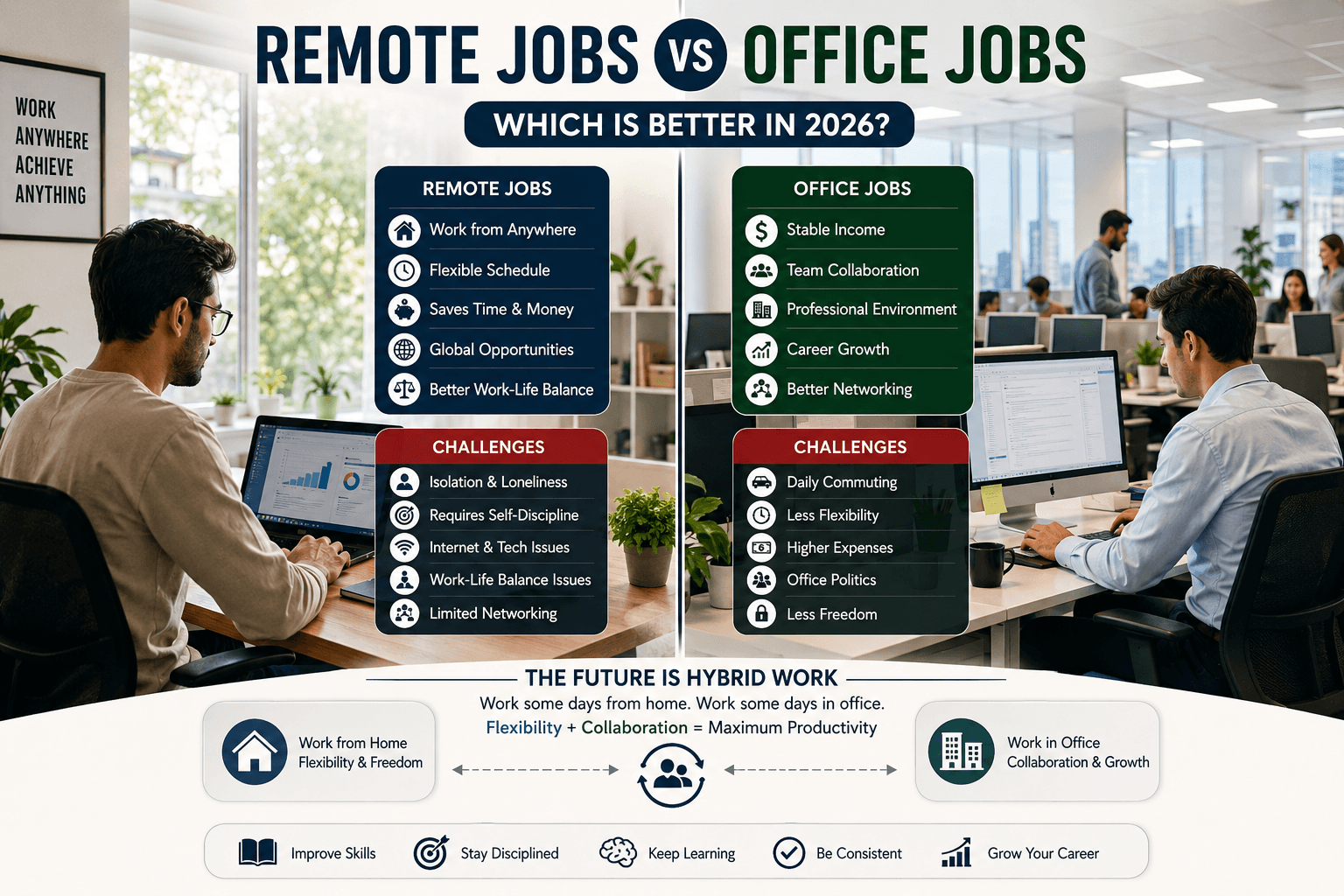
Introduction
In recent years, there has been a significant shift in how individuals work. Millions of people can now work from anywhere in the world thanks to technology, the internet, and digital communication tools. As a result, remote jobs vs office jobs has become a popular topic of discussion in 2026. However, many businesses and industries still value traditional office jobs.
Nowadays, a lot of people are unsure about whether working remotely or in an office is preferable. While some people value the structure and social atmosphere of an office, others prefer the comfort and flexibility of working from home.
There are benefits and drawbacks to both office and remote work. A person’s lifestyle, personality, professional objectives, and work preferences all influence the ideal option.
In this article, you will learn:
- What remote jobs are
- What office jobs are
- Major differences between them
- Benefits and disadvantages of each
- Real-life examples
- Which option may be better for beginners
- Future of remote work in 2026
What Are Remote Jobs?
Remote jobs are jobs that allow employees to work outside a traditional office. People usually work from home, coffee shops, co-working spaces, or anywhere with an internet connection.
Remote workers communicate using:
- Zoom
- Google Meet
- Slack
- Microsoft Teams
- Email
- Project management tools
In remote jobs, employees complete tasks online without physically going to an office every day.
Examples of Remote Jobs
Some popular remote jobs include:
- Content Writing
- Graphic Design
- Video Editing
- Web Development
- Digital Marketing
- Virtual Assistant
- Customer Support
- Social Media Management
- Online Teaching
- Data Entry
- Freelancing
Many companies now hire employees from different countries because remote work allows businesses to access global talent.
What Are Office Jobs?
Office jobs are traditional jobs where employees work from a physical workplace or company office.
Workers travel daily to their workplace and perform tasks under direct supervision.
Office jobs usually have:
- Fixed schedules
- Physical meetings
- Team collaboration
- Face-to-face communication
- Office rules and environments
Examples of Office Jobs
Common office jobs include:
- Bank Employees
- Receptionists
- Accountants
- Government Workers
- Corporate Managers
- Human Resource Staff
- Sales Executives
- Office Administrators
- Lawyers
- Engineers
Some industries still require physical presence because certain tasks cannot be done remotely.
Main Differences Between Remote Jobs and Office Jobs
1. Work Location
Remote Jobs
You can work from home or anywhere with internet access.
Office Jobs
You must travel daily to a company office.
2. Flexibility
Remote Jobs
Many remote jobs offer flexible schedules.
Office Jobs
Office jobs usually follow fixed working hours.
3. Communication Style
Remote Jobs
Communication happens through online tools.
Office Jobs
Face-to-face communication is more common.
4. Work Environment
Remote Jobs
You control your workspace and environment.
Office Jobs
The company controls the work environment.
5. Transportation
Remote Jobs
No daily commuting is needed.
Office Jobs
Employees spend time and money traveling.
Advantages of Remote Jobs

1. Flexible Lifestyle
One of the biggest benefits of remote work is flexibility.
People can:
- Choose their work environment
- Manage personal schedules
- Work while traveling
- Spend more time with family
This flexibility improves work-life balance.
2. Saves Time and Money

Remote workers save money because they do not need to:
- Pay transportation costs
- Buy office clothes frequently
- Spend money eating outside daily
They also save commuting time.
For example:
A person who spends 2 hours daily traveling can use that time for:
- Learning skills
- Freelancing
- Rest
- Exercise
- Family activities
3. More Freedom
Remote workers often feel more independent because they manage their own work routines.
This freedom can increase creativity and productivity.
4. Global Opportunities
Remote jobs allow people to work for companies worldwide.
For example:
A person living in Nepal can work for:
- US companies
- UK startups
- Australian businesses
- International clients
This creates more earning opportunities.
5. Better for Introverts
Some people work better in quiet environments.
Remote jobs reduce:
- Office distractions
- Noise
- Workplace pressure
This helps many people focus better.
Disadvantages of Remote Jobs
Despite the benefits, remote jobs also have challenges.
1. Isolation and Loneliness
Working alone for long periods may create loneliness.
People miss:
- Social interaction
- Team activities
- Office friendships
2. Requires Self-Discipline
Remote workers must manage time properly.
Without discipline, people may:
- Waste time
- Get distracted
- Miss deadlines
3. Communication Challenges
Online communication can sometimes create misunderstandings.
Internet problems may also interrupt meetings or work.
4. Work-Life Balance Problems
Some remote workers struggle to separate work from personal life.
Because they work from home, they may:
- Overwork
- Work late nights
- Feel mentally exhausted
5. Limited Networking
Office jobs provide more face-to-face networking opportunities.
Remote workers may have fewer chances to build professional relationships.
Advantages of Office Jobs

Traditional office jobs still provide many important benefits.
1. Better Team Collaboration
Working together physically allows employees to communicate quickly and solve problems faster.
Face-to-face meetings improve teamwork.
2. Professional Environment
Office environments help employees stay focused and productive.
There are fewer home distractions.
3. Easier Career Growth
Managers can directly observe employee performance in offices.
This sometimes helps workers get:
- Promotions
- Leadership roles
- Better networking opportunities
4. Social Interaction
Office jobs provide opportunities to:
- Make friends
- Build relationships
- Enjoy team activities
This can improve mental health and motivation.
5. Clear Work Boundaries
Office workers usually leave work at the office.
This creates better separation between:
- Work life
- Personal life
Disadvantages of Office Jobs
Office jobs also have several disadvantages.
1. Daily Commuting
Traveling daily wastes:
- Time
- Energy
- Money
Traffic can also create stress.
2. Less Flexibility
Office schedules are usually fixed.
Employees may have limited control over:
- Working hours
- Break times
- Vacation schedules
3. Office Politics
Some offices have workplace politics, conflicts, or unhealthy competition.
This can affect employee happiness.
4. Higher Expenses
Office workers often spend money on:
- Transportation
- Lunch
- Clothing
- Fuel
5. Less Freedom
Employees must follow office rules and company schedules strictly.
Real-Life Example: Remote Job

Example 1: Freelance Graphic Designer
A graphic designer from Nepal works remotely for international clients through Fiverr and Upwork.
Benefits:
- Works from home
- Chooses projects freely
- Earns in dollars
- Flexible schedule
Challenges:
- Finding clients
- Managing deadlines
- Working alone
Real-Life Example: Office Job
Example 2: Bank Employee
A bank employee works in a physical branch daily.
Benefits:
- Stable salary
- Team environment
- Career growth opportunities
Challenges:
- Fixed schedule
- Daily commuting
- Office pressure
Which Is Better for Beginners?
The answer depends on your goals.
Remote Jobs May Be Better If You:
- Want flexibility
- Like independent work
- Want global opportunities
- Prefer working from home
- Want to start freelancing
Office Jobs May Be Better If You:
- Need stable income
- Prefer teamwork
- Want direct guidance
- Enjoy social interaction
- Need structured work environments
Hybrid Work: The New Trend

In 2026, many companies use hybrid work models.
Hybrid work means:
- Employees work some days from home
- Employees work some days in the office
This combines benefits of both systems.
For example:
- Monday to Wednesday → Office
- Thursday to Friday → Remote work
Many experts believe hybrid work is the future.
Future of Remote Jobs in 2026
Remote work continues growing rapidly because of:
- Faster internet
- AI tools
- Cloud technology
- Global hiring
- Digital businesses
Companies now realize remote workers can be highly productive.
Many online careers are expected to grow, including:
- AI-related jobs
- Content creation
- Remote customer support
- Online teaching
- Digital marketing
- Web development
Skills Needed for Remote Jobs
To succeed remotely, people need skills such as:
- Communication
- Time management
- Self-discipline
- Digital skills
- Problem-solving
- Online collaboration
Learning these skills can improve remote career success.
Tips for Success in Remote Jobs
Create a Dedicated Workspace
Have a quiet area for work.
Manage Time Properly
Use schedules and productivity tools.
Avoid Distractions
Limit social media during work hours.
Improve Communication
Respond professionally and clearly.
Keep Learning
Upgrade skills regularly.
Tips for Success in Office Jobs
Be Professional
Maintain discipline and punctuality.
Build Relationships
Network with coworkers and managers.
Improve Teamwork
Learn collaboration skills.
Stay Organized
Manage tasks efficiently.
Continue Learning
Develop new professional skills.
Remote Jobs vs Office Jobs: Quick Comparison
| Feature | Remote Jobs | Office Jobs |
|---|---|---|
| Work Location | Anywhere | Physical office |
| Flexibility | High | Limited |
| Social Interaction | Less | More |
| Commuting | No | Yes |
| Freedom | More | Less |
| Team Collaboration | Online | Face-to-face |
| Expenses | Lower | Higher |
| Work-Life Balance | Can be difficult | More structured |
Final Thoughts
Both remote jobs and office jobs have strengths and weaknesses.
Remote jobs provide:
- Freedom
- Flexibility
- Global opportunities
Office jobs provide:
- Stability
- Social interaction
- Structured environments
There is no single perfect option for everyone.
Some people succeed better remotely, while others perform better in offices.
In 2026, the best approach may be hybrid work because it combines flexibility with collaboration.
No matter which path you choose, improving your skills, staying disciplined, and continuing to learn are the most important factors for career success.
Frequently Asked Questions (FAQs)
Yes. Many companies hire remote workers worldwide.
Can beginners get remote jobs?
Yes. Beginners can start with freelancing, data entry, customer support, or content writing.
Which pays more: remote or office jobs?
It depends on skills, experience, and industry.
Are remote jobs safe?
Many are safe, but people should avoid scams and use trusted platforms.
Is remote work the future?
Yes. Remote and hybrid work are growing rapidly worldwide.
Can I do remote work from Nepal?
Yes. Many Nepali freelancers and professionals work remotely for international clients.